Wednesday, September 5, 2012

Thursday, April 12, 2012
Crazy Strategy
It just really sticks in my craw, how President Obama bent over backwards to be nice to Republicans at the outset of the "Health Care Debate". Obama basically said that Republicans needed to be nice to him, because Republicans who weren't nice to him would suffer the anger of an outraged public who LOVE the President.
So,
1) The President was being pre-emptively nice to Republicans, expecting them to return the favor, and to act in their best interest.
But more astoundingly,
2) The President was doing his best to help Republicans get re-elected: "Vote for my health care law, and you will get re-elected."
...and this was when the Democrats had majorities in the House and the Senate. The president's strategy should have been, "Let's get a really populist health care bill through Congress and to my desk - one which the American people will love and which the Republicans will all vote against. Then we will get even MORE Democrats in Congress as the Republicans suffer popular disdain."
But no.
Sunday, March 25, 2012
America' messed-up income distribution
Check out this chart:
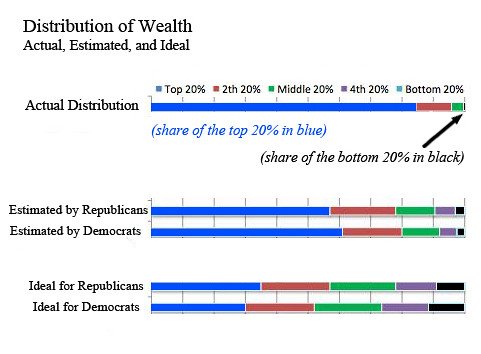 [http://farm8.staticflickr.com/7195/7009135329_2c597b4a63.jpg]
(Sure, it's distribution of wealth, but the wealth got there through income, whether earned through innovation or earned through inheritance.)
If income were more equally distributed, then
(1) there would be a lot fewer unemployed spending down the social safety nets,
(2) economic activity would be high, because of the higher spending by the expanded working classes, and
(3) the expanded working classes would be paying a lot more in taxes.
So how does the income get redistributed to the working classes? The high-income groups are not going to voluntarily take a pay cut, and simply printing money to pay the working classes while maintaining the high income class will devalue American currency. No, we need a sin tax on high incomes, to discourage large paychecks, like the 91% federal income tax in the 1950s, which - combined with state and local income taxes - put a cap of $400,000/year on income.
But this would be tough to implement today - even adjusted to a $2 million cap, based on inflation - because politicians and the media "rely" on that excess income as contributions/ads and as future guaranteed income (if they play ball).
Friday, October 28, 2011
Here's why "49% of Americans don't pay taxes"
From dirk, reposted at Eschaton:
I suspect what you mean is that 49% don't pay federal income tax, because they don't have enough income. They certainly pay taxes - even part time minimum wage earners pay FICA. Many that are exempt from federal taxes still pay state income tax. All pay excise tax, gas tax, telecommunications tax, and property tax (directly or indirectly, unless they are homeless.) I'd be more concerned that half the country doesn't have enough income to be taxable while the top 1% of the population owns 40% of the wealth.
But who is in that 49 "bottom" percent? Well, lets start with a 9% unemployment rate. An awful lot of people currently unemployed have worked before (and paid income tax, and will again.) Then there are the seniors who worked all their lives (and paid taxes) but are now retired - should they be paying income tax? We have one of the largest percentage of prison inmates in the civilized world, none of them pay taxes. And of course full time students generally don't make enough to pay income tax. Oh, and the mafia. And General Electric (corporations are people too.)
So how about the low, low, just-above-poverty people who don't pay taxes? Not pulling their fair share? Well, think about what it really costs to run a country and how that money is spent. Sure, they get food stamps I suppose. Some might even scam an extra couple hundred dollars a year from a program like that, and I won't deny that there is waste in social programs. But how many of those people fly (the FAA and TSA are pretty expensive to run,) how much of their "stuff" does the police, fire department and military protect, how often do they get to go to national parks or send their company's shipments over the interstate system or utilize the rural electrification grid to power their agribusinesses or rely on the State Department when traveling to their overseas subsidiaries or call the Coast Guard when their boat gets beached or have the CDC debug their pharmaceuticals or .. a million other things that those of means can do largely because of the infrastructure and largess of the federal government? Who benefits? Who should pay a larger share?
Taxes on the wealthy are at historic lows, but none of these reductions have resulted in employment or opportunities for anyone except those who already have so much. Productivity has soared enriching the owners while impoverishing labor. The wealth gap is higher than it has ever been, and far higher than anywhere else in the world.
This inflammatory nonsense about "49% don't pay tax" is not only a lie, it pushes responsibility for the horrible state of the economy (unless you are in the top 1-5% in which case you are doing better every year) onto the victims, and the ones who have the least control over it.
How's that for economic understanding?
Monday, October 24, 2011
The cost of ads on primetime broadcast television, 2011
It only costs a half a million dollars to put a 30-second ad on Sunday Night Football. That's pocket change to corporate "managers" who are backing a political candidate.
http://adage.com/article/mediaworks/chart-american-idol-nfl-duke-priciest-tv-spot/230547/#sun
Long TV's most expensive program for advertisers, "American Idol" is now neck-and-neck with NBC's "Sunday Night Football" as the costliest prime-time show on this year's schedule, according to Advertising Age's annual survey of the costs of running a 30-second commercial in prime time. The average cost of running a 30-second ad in "Idol" runs between $468,100 and $502,900, according to the Ad Age survey, while the average cost of a 30-second ad in NBC's much-watched football contest is $512,367.
Tuesday, October 18, 2011
I'm not anti-capitalism or anti-corporation
I'm not anti-capitalism: I'm anti-bribery. Low taxes allow those with giant paychecks to bribe politicians with threats of withholding campaign contributions if those taxes are increased. The media refuses to point this out, because they are also being bribed.
I'm not anti-capitalism: I'm anti-outsourcing jobs to foreign countries so a few American corporate managers and corporations can make extra money. The politicians love the outsourcing of jobs, because they get to point at the profits America-based companies make, and the media loves it because these American companies then buy ads/sponsorships.
I'm not anti-capitalism: I'm anti-deregulation. Corporate managers have found out they can make more profits if they don't have to adhere to regulations protecting workers, neighborhoods, and the environment. But since more profits means higher salaries and bonuses, the managers can then bribe the politicians to continue deregulation, under threats of withholding campaign contributions. As always, the media cares about "ad revenue", and so will shut up and take the money rather than talk about the downsides of deregulation.
Thursday, October 13, 2011
The Corporations Are Not The Problem
People are losing sight of the objective of the 99% movement: it's to keep corporate *management* influence out of politics and the media, not corporations in and of themselves.
It's not the corporations that are the problem, because the *owners* of the companies are we-the-shareholders, and the *worker-bees* are we-the-workers. Rather, the problem is the corporate *managers*, who - through boards of directors (who are also managers) - get enormous compensation packages. These managers and board members then make - or withhold - campaign contributions, depending on politicians' stances on "tax breaks".
If the politicians play nice with corporate managers, then the politicians get their campaign contributions, so they can buy commercial time from TV/radio/magazines. And whose ads are those politicians bumping aside? Ads bought by the ad executives at the companies managed by these same corporate managers. Of course, corporate taxes "need" to remain low, as well, so those corporations can "afford" to buy those ads in the first place.
So:
Low personal tax rates buys political influence. The media wants a cut of the action as well, but corporate ad executives buy ads, so low corporate tax rates are necessary to keep the media happy. Politicians want low personal income taxes; the media wants low corporate income taxes.
But politicians are also looking to make a lot of money, personally, so low personal tax rates are self-serving. Same goes for media moguls. Plus, those media moguls want to see low corporate tax rates so the media conglomerates can be a vehicle to hoard more money and buy up TV stations, put up ads on billboards, hand out bonuses, etc.
Politicians control the flow of money, through taxes; media moguls control the flow of information, through access to the public-at-large.
Subscribe to:
Posts (Atom)
Let's assume that figure is $300 billion/year. Give that amount of money to the bottom 95% - 300 million Americans - in the form of a $1000 check per year.
They will then spend that money and stimulate demand.
Scale that $1000 back as wages start to rise, and inflation forces the top 5% to spend their money instead of hoarding it.