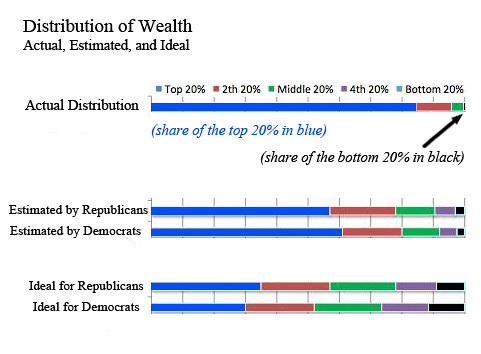
Check out this chart:
 [http://farm8.staticflickr.com/7195/7009135329_2c597b4a63.jpg]
(Sure, it's distribution of wealth, but the wealth got there through income, whether earned through innovation or earned through inheritance.)
If income were more equally distributed, then
(1) there would be a lot fewer unemployed spending down the social safety nets,
(2) economic activity would be high, because of the higher spending by the expanded working classes, and
(3) the expanded working classes would be paying a lot more in taxes.
So how does the income get redistributed to the working classes? The high-income groups are not going to voluntarily take a pay cut, and simply printing money to pay the working classes while maintaining the high income class will devalue American currency. No, we need a sin tax on high incomes, to discourage large paychecks, like the 91% federal income tax in the 1950s, which - combined with state and local income taxes - put a cap of $400,000/year on income.
But this would be tough to implement today - even adjusted to a $2 million cap, based on inflation - because politicians and the media "rely" on that excess income as contributions/ads and as future guaranteed income (if they play ball).
(Sure, it's distribution of wealth, but the wealth got there through income, whether earned through innovation or earned through inheritance.)
If income were more equally distributed, then
(1) there would be a lot fewer unemployed spending down the social safety nets,
(2) economic activity would be high, because of the higher spending by the expanded working classes, and
(3) the expanded working classes would be paying a lot more in taxes.
So how does the income get redistributed to the working classes? The high-income groups are not going to voluntarily take a pay cut, and simply printing money to pay the working classes while maintaining the high income class will devalue American currency. No, we need a sin tax on high incomes, to discourage large paychecks, like the 91% federal income tax in the 1950s, which - combined with state and local income taxes - put a cap of $400,000/year on income.
But this would be tough to implement today - even adjusted to a $2 million cap, based on inflation - because politicians and the media "rely" on that excess income as contributions/ads and as future guaranteed income (if they play ball).

No comments:
Post a Comment